Sustainability –
Property for the future
With our projects, we actively participate in the further development of cities and are very conscious of the fact that in doing so, we also assume responsibility for people and the environment. For those who live in them, but also for those with whom we work together on our projects. We therefore ensure that all our actions are guided by the criteria of environmental, social and governance (ESG) – all processes and aspects of our work are ESG-compliant.
 © Mir
© MirESG in the
HAMBURG TEAM Group
Making a big difference always begins one tiny step at a time. That’s why we pay attention to the impact that even the most everyday actions have on the future - ecologically, socially and legally. As such, we only ever use sustainable office materials in our offices, utilize green electricity, and offer fair-trade coffee. We pay attention to ergonomic workplaces and healthy lunches as well as to regular training for our employees.
To ensure that we always have our finger on the pulse when it comes to ESG, we have set up a task force specifically for this purpose.
ESG in
developments
Buildings account for around 40% of energy consumption and emissions in the European Union. Therefore, the responsibility we have as developers is considerable, and we strive to live up to it in each and every project. Our commitment begins with the efficient planning of our projects, continues with green or retention roofs and rainwater management, and is finalized with the use of renewable energy sources and high energy standards.
Of course, we also attach great importance to social aspects. Age-appropriate, barrier-free living or special arrangements for student housing are just as much a part of our projects as working in partnership with public and social institutions or implementing neighbourhood management structures in larger mixed-use neighbourhoods.
In all our activities, we comply with the current legislation on minimum wages and on curbing illegal employment. For us, this is a matter of course.
Our partnerships
HAMBURG TEAM is an innovation partner in the integral platform Madaster, providing insights into recycling management, separability, bound CO₂ and the value of commodities in financial terms. As a part of the network, we engage at an early stage in the development of new, advanced approaches for the continuous advancement of sustainable development. The partnership seeks to contribute positively to our built environment while meeting environmental and social demands.
In July 2023, we joined the Berlin association Transiträume to make open spaces in our properties available for interim cultural use. Transiträume Berlin e.V. organizes the use of vacant properties and mediates between creatives, politicians and property owners. By offering spaces for art and culture, we wish to contribute to revitalizing locations and especially urban districts.
Sustainable projects
 © Mir
© MirHAINWERK
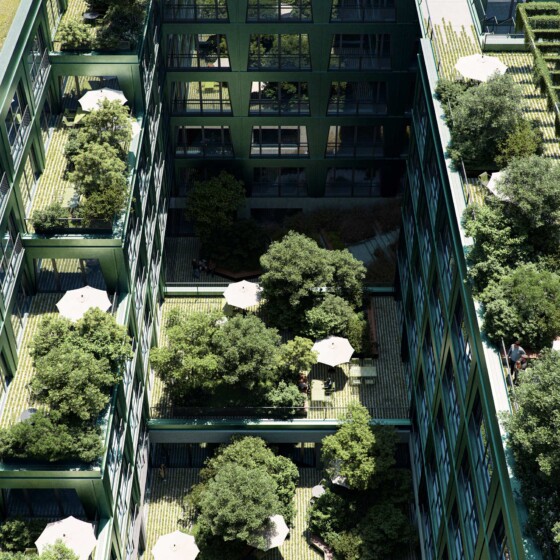
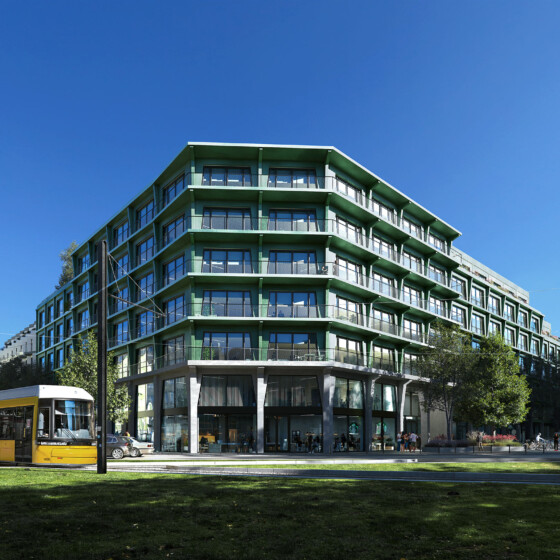
The sustainably designed building in timber hybrid construction will have a self-sufficient regenerative energy supply from geothermal energy, photovoltaics and air heat pumps. The green ensemble in Berlin-Friedrichshain is being developed as an Efficiency House 40 and according to the cradle-to-cradle design principle − awarded DGNB Platinum (pre-certification).
Campus Schätzelberg
The inclusion campus in Berlin-Mariendorf, idyllically located in the midst of grounds of mature tree stock, will house residential units and a nursery, and will also incorporate a central social building with an inclusionary use at its very center.
Löwitz Quartier
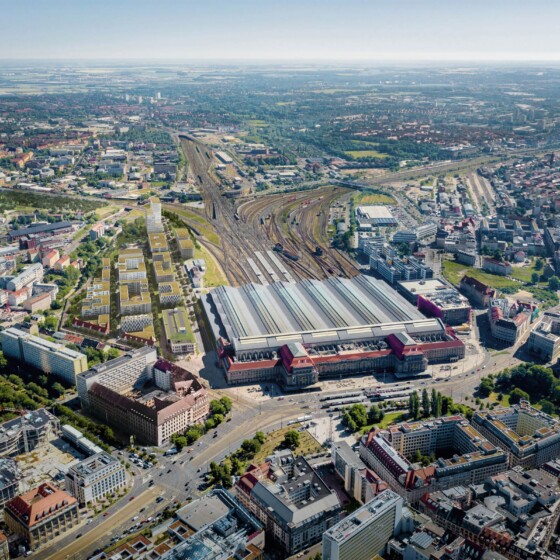
The Löwitz Quartier is also committed to using resources as efficiently as possible as a measure to protect the environment. An innovative heating concept with local heating connection and ice storage tanks is planned, which will contribute to the high sustainability quality of the quarter, which has been pre-certified with DGNB Gold.
 © Burkhard Katz
Insel 3
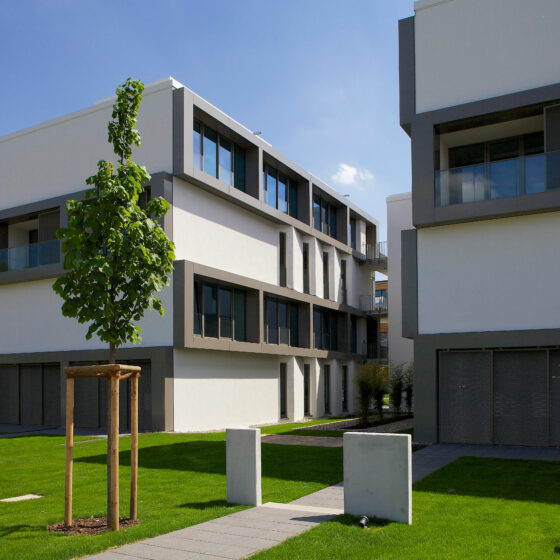
The Insel 3 building was constructed according to the energy standard of the KfW Efficiency House 70 (EnEV 2009) with controlled ventilation and heat recovery. The project was developed within the framework of the IBA 2013. The building exceeds the energy standard of the KfW efficiency house (EnEV 2009) by 30% as part of the requirements for projects under the IBA 2013.
ESG in
investment management
We do not only act sustainably when constructing buildings. When it comes to our investment products in particular, we take a close look at whether our actions are also in the best interests of future generations. Sustainability is not just one of many factors in our investment strategy, it is decisive - for both ourselves and our investors, as well as for the environment in which we invest.
HAMBURG TEAM Investment GmbH is a partner in multiple sustainability projects.
Since 2019, we have also been a partner of the PRI - Principles for Responsible Investments investor initiative launched by the United Nations. You can access our Responsible Investment Policy here.
We became a member of the German federal initiative Impact Investing in July 2023. In working groups and within the scope of various projects, we are actively involved in the expansion and deepening of impact investing in Germany. The initiative pursues the vision of regenerative investing and economic activity that respects both ecological limits and social standards.
On behalf of our investors, we are involved in various fundraising projects. We sponsor a bee colony at BEE-RENT, for example, and donate to the German Depression Aid Foundation, which aims to improve care for people suffering from depression and reduce the incidence of death by suicide in Germany. We also make annual donations to „Die Arche“, which is dedicated to helping children from socially disadvantaged backgrounds. We also support the Ottobock Global Foundation, which provides injured war refugees with prostheses, orthoses and wheelchairs, as well as the Loki Schmidt Stiftung, which has been buying, planning and maintaining land for nature conservation for 40 years. Another initiative that can count on us as a donation partner is the „Money Hangs on Trees“ project, which harvests leftover fruit and continues to process this into juices.
Since the establishment of HTIM, our fund products have been increasingly investing in subsidized and affordable rental housing, housing for the elderly, and energy-efficient new buildings (especially KfW-55 standard or higher).
On March 10, 2021, the EU Disclosure Regulation came into force, the main intention of which is to encourage sustainable investment. It is designed to help investors in their product selection by classifying funds into three different categories, which correspond to Articles 6, 8 and 9 of the Regulation. We have already started to classify the first two of our existing funds as ESG strategy funds as defined in Article 8 and plan to initiate all other funds as ESG strategy funds as defined in Article 8 or 9 going forward.
ESG in
property management
We are a modern and customer-oriented property manager, and the sustainability of real estate is an important factor in our day-to-day operations. We take care to balance environmental, social and governance criteria. An economical and responsible use of available resources while maintaining economic efficiency is a decisive aspect. We also see it as our duty to raise awareness among tenants and service providers so that they conduct their activities in a more sustainable manner. Digitization is a general prerequisite for a functioning sustainability strategy, so that the data can be used and compared for relevant evaluation processes.
We have implemented the following ESG measures on an ongoing basis:
- Supplying all managed properties with green electricity and climate-friendly gas.
- Successive introduction of a digital energy management system through smart metering
- Sustainability preambles and clauses in rental agreements
- Support with regard to certifications
- Implementation of and compliance with energy standards in refurbishments and modernisations